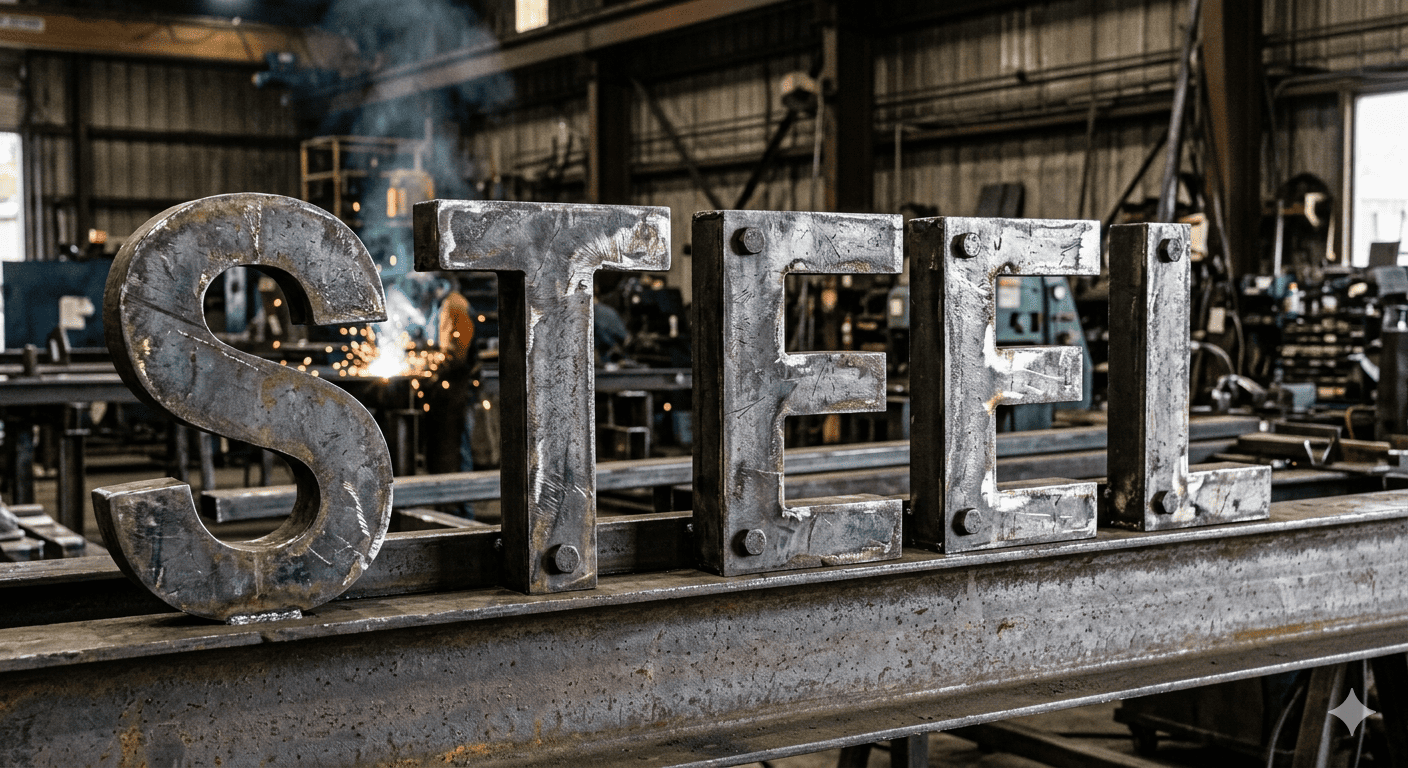
SM490 (JIS G3106) is Japan’s standard weldable structural steel for bridges, buildings, and pressure vessels. Unlike SS400, SM490 controls carbon equivalent (Ceq) and Charpy impact toughness — making it a true counterpart to ASTM A572 Grade 50 and EN S355. This guide covers international equivalents, chemical composition, mechanical and physical properties, heat treatment, weldability, and the specification mistakes that cause failures in the field.
- International Equivalent Grades
- Chemical Composition
- Mechanical Properties
- Physical Properties
- Heat Treatment Conditions
- Machinability
- Weldability
- Common Mistakes
- When to Choose SM490
- FAQ
1. International Equivalent Grades
SM490 is a Japanese Industrial Standard (JIS G3106) weldable structural steel rolled plate and section. The three sub-grades — SM490A, SM490B, and SM490C — differ only in Charpy impact requirements. All three share the same tensile strength range and composition limits.
| Standard | Grade | Region | Match Type |
|---|---|---|---|
| JIS G3106 | SM490A / SM490B / SM490C | Japan | Reference |
| ASTM A572 / A572M | Grade 50 | USA | ✅ Nearest Exact |
| EN 10025-2 | S355J0 / S355J2 | Europe | ✅ Nearest Exact |
| DIN EN 10025-2 | S355J2+N | Germany | ✅ Nearest Exact |
| GB/T 1591 | Q355 | China | ⚠️ Nearest Equivalent |
Sub-grade Impact Requirements
| Sub-grade | Charpy Test Temperature | Minimum Energy | EN Equivalent |
|---|---|---|---|
| SM490A | No requirement | — | S355JR (no impact) |
| SM490B | 0°C (32°F) | ≥ 27 J (≥ 20 ft·lbf) | S355J0 |
| SM490C | −5°C (23°F) | ≥ 27 J (≥ 20 ft·lbf) | S355J2 (−20°C in EN) |
Sources: JIS G3106:2020 (JSA), ASTM A572/A572M-21, EN 10025-2:2019
2. Chemical Composition
SM490’s primary structural feature is its mandated carbon equivalent (Ceq ≤ 0.44%), which is absent from SS400. This limit ensures predictable weldability across the full thickness range covered by the standard.
| Element | SM490A | SM490B / SM490C | ASTM A572 Gr.50 |
|---|---|---|---|
| C | ≤ 0.20% | ≤ 0.18% | ≤ 0.23% |
| Si | ≤ 0.55% | ≤ 0.55% | — |
| Mn | ≤ 1.60% | ≤ 1.60% | ≤ 1.35% |
| P | ≤ 0.035% | ≤ 0.035% | ≤ 0.040% |
| S | ≤ 0.035% | ≤ 0.035% | ≤ 0.050% |
| Ceq | ≤ 0.44% | ≤ 0.44% | (no limit specified) |
Key distinction: ASTM A572 Gr.50 allows C up to 0.23% and imposes no Ceq limit. In practice, most A572 Gr.50 mill heats fall within SM490 Ceq limits — but this is not guaranteed. For certified welding procedures (WPS/PQR), always verify the actual mill cert chemistry rather than relying on the maximum-allowable specification.
Sources: JIS G3106:2020, ASTM A572/A572M-21
3. Mechanical Properties
| Property | Metric | Imperial |
|---|---|---|
| Tensile strength | 490–610 MPa | 71.1–88.5 ksi |
| Yield strength (t ≤ 16 mm / ≤ 0.63 in) | ≥ 325 MPa | ≥ 47.1 ksi |
| Yield strength (16 < t ≤ 40 mm / 0.63–1.57 in) | ≥ 315 MPa | ≥ 45.7 ksi |
| Yield strength (40 < t ≤ 75 mm / 1.57–2.95 in) | ≥ 295 MPa | ≥ 42.8 ksi |
| Elongation | ≥ 21–23% | ≥ 21–23% |
| Charpy impact (SM490B, 0°C / 32°F) | ≥ 27 J | ≥ 20 ft·lbf |
| Charpy impact (SM490C, −5°C / 23°F) | ≥ 27 J | ≥ 20 ft·lbf |
Sources: JIS G3106:2020 Table 3 and Table 4
4. Physical Properties
| Property | Metric | Imperial |
|---|---|---|
| Density | 7.85 g/cm³ | 0.284 lb/in³ |
| Young’s modulus | 206 GPa | 29,900 ksi |
| Thermal conductivity | 48 W/(m·K) | 332 BTU·in/(hr·ft²·°F) |
| Thermal expansion (20–100°C / 68–212°F) | 12.0 × 10⁻⁶ /°C | 6.7 × 10⁻⁶ /°F |
5. Heat Treatment Conditions
SM490 is normally supplied in the as-rolled or normalized condition. It is not a heat-treatable high-strength steel; quench-and-temper is not part of the JIS G3106 specification.
| Process | Temperature | Cooling | Purpose |
|---|---|---|---|
| As-rolled | — | — | Standard delivery condition |
| Normalizing | 900–940°C (1652–1724°F) | Air cool | Grain refinement; improve uniformity |
| PWHT (stress relief) | 600–650°C (1112–1202°F) | Slow furnace cool | Reduce residual welding stress |
PWHT hold time: 1 hour per 25 mm (1.0 in) of section thickness, minimum 1 hour.
Do not exceed 650°C (1202°F) during PWHT. Temperatures above this range can reduce yield strength below JIS G3106 minimum values. Always confirm that the stress-relieved certificate reports mechanical properties, not just the as-rolled values.
6. Machinability
SM490 machines at approximately 65–70% of the AISI 1212 baseline. Low carbon content (≤ 0.18–0.20%) keeps the as-rolled material soft enough for routine drilling, sawing, and milling operations without special tooling.
Practical Machining Notes
- Structural sections are rarely machined beyond drilling bolt holes and plasma/flame cutting.
- Flame-cut edges develop a hardened zone (up to HRC 35–40) up to 3–5 mm (0.12–0.20 in) deep. Use carbide tooling for any finish machining of flame-cut surfaces.
- HSS tooling is adequate for drilling in the as-rolled condition.
- Apply cutting fluid when drilling t > 25 mm (1.0 in) to control heat.
7. Weldability
Weldability is SM490’s defining advantage over SS400. The Ceq limit (≤ 0.44%) provides a controlled, predictable HAZ hardness across the full product thickness range.
Preheat Requirements
| Plate thickness | Ambient temp ≥ 5°C (41°F) | Ambient temp < 5°C (41°F) |
|---|---|---|
| t ≤ 25 mm (1.0 in) | No preheat required | Preheat to 50°C (122°F) |
| 25 < t ≤ 50 mm (1.0–2.0 in) | Preheat 50–100°C (122–212°F) | Preheat 75–100°C (167–212°F) |
| t > 50 mm (2.0 in) | Preheat 100°C (212°F) min | Preheat 100–150°C (212–302°F) |
Recommended Filler Metals
| Process | Recommended Filler | Notes |
|---|---|---|
| SMAW | E7018 / E71T-1C | Low-hydrogen electrode; bake before use |
| GMAW (MIG) | ER70S-6 | Suitable for all-position welding |
| SAW | F7A2-EH14 / F7A4-EH14 | Used for heavy structural fabrication |
Sources: JIS Z3010 (preheat guidance), AWS D1.1 Table 3.2 (filler matching)
8. Common Mistakes
SM490A has no Charpy impact requirement. For bridges, offshore structures, or any component exposed to sub-zero temperatures, SM490A is not a valid substitution for SM490B (0°C / 32°F tested) or SM490C (−5°C / 23°F tested). All three sub-grades share the same price tier — there is no cost saving from specifying SM490A on an impact-critical application. The failure mode is brittle fracture during cold-weather erection or service, which in structural steelwork can be catastrophic and non-detectable before the event.
ASTM A572 Gr.50 allows C up to 0.23% and imposes no Ceq limit. For standard structural applications this difference is rarely significant, because most A572 mill heats fall within SM490 Ceq limits in practice. However, for certified welding procedures (WPS/PQR), the qualifying standard matters: a procedure qualified on A572 Gr.50 with a high-Ceq heat may not cover SM490B/C chemistry (or vice versa) if the base metal P-number grouping or Ceq brackets are different under the applicable welding code (AWS D1.1, JIS Z3040). Always verify the specific mill cert chemistry against the WPS base metal range before fabrication.
9. When to Choose SM490
- ✅ Bridge fabrication requiring JIS G3106 certification from a Japanese or JIS-certified mill
- ✅ Building structures requiring 355 MPa yield class — the SM490/S355 structural family
- ✅ Pressure vessels and heavy weldments where Ceq-certified chemistry is mandatory per the design code
- ✅ Replacing S355J0/J2 in Japanese domestic supply chains where EN-certified plate is not available
- ❌ Atmospheric-exposure-only applications with no welding — SS400 is cheaper and fully adequate
- ❌ High-temperature service above 200°C (392°F) sustained — use SA-516 Gr.70 or equivalent pressure vessel grade with elevated-temperature allowables
- ❌ When quenched-and-tempered high-strength steel is required (≥ 690 MPa / 100 ksi yield) — specify SM570, HT780, or an equivalent TMCP high-strength grade
10. FAQ
What is the difference between SM490 and SS400?
SS400 is a minimum-strength structural steel with no weldability control: no Ceq limit, no Charpy impact requirement, and a higher allowable C content. SM490 is explicitly designed for welded structures. It mandates Ceq ≤ 0.44%, imposes a tighter C limit (≤ 0.18–0.20% vs ≤ 0.25% for SS400), and offers sub-grades with verified Charpy toughness. SM490 costs slightly more, but it is the correct specification for any application where welding is performed and structural integrity under load must be certified.
Does SM490 require preheat?
No preheat is required for t ≤ 25 mm (1.0 in) when ambient temperature is ≥ 5°C (41°F). For t > 25 mm (1.0 in) or ambient temperatures below 5°C (41°F), preheat to 50–100°C (122–212°F) depending on thickness. JIS Z3010 provides the full decision matrix for preheat requirements on JIS structural steels.
Is SM490 the same as S355?
Mechanically, yes — yield strength ≥ 325 MPa for t ≤ 16 mm (0.63 in), tensile 490–610 MPa. Composition limits differ slightly. S355J0 (0°C Charpy) maps to SM490B; S355J2 (−20°C Charpy in EN, vs −5°C in JIS for SM490C) is the closest EN counterpart. For procurement in a mixed JIS/EN supply chain, treat them as equivalent but verify the exact Charpy test temperature required by your design code. The EN impact test temperature for S355J2 is more demanding (−20°C / −4°F vs −5°C / 23°F for SM490C).
comment